PIONEER MACHINERY
Taiwan Headquarters
9 Minzu St., Tucheng Dist., New Taipei City 23679, Taiwan
Tel
+886 2 2268 1188
Email
info@pioneerm.com
IoT Service
iotservice@pioneerm.com
Office Hours
Monday–Friday: 08:00–17:00

Meet Stanley ” Think ahead of those simple and easy concepts. Work on them and make innovation.
Stanley’s Internship Experience
Since the summer of my sophomore year, I have completed three internships at Pioneer Machinery, utilizing both summer breaks and the period after graduation. My work content evolved with each visit.
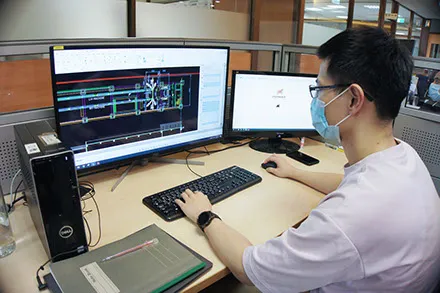
Third Internship: I was responsible for modifying output drawings for power pay-off stand orders and planning for future standard machinery. Compared to the second internship, this design improvement involved more discussion and revision to ensure all designs met order requirements while effectively reducing production costs. During discussions, while errors or parts requiring revision were inevitable, each correction ensured the design was foolproof and refined my design concepts to be more precise. Regarding the drawings, I had to consider how parts would be manufactured; different processing methods and precision requirements demand different annotation styles. Attention to detail is crucial here—one oversight could easily lead to missing dimensions or non-compliance with standards.
First Internship: My work involved simply converting 2D CAD drawings into 3D Solidworks models. This allowed me to grasp the overall structure of the machines more quickly and helped me become more proficient with Solidworks.
Second Internship: My main focus was managing the standard machine Bill of Materials (BOM), improving the 330 wire accumulator, and exploring the effects of heat treatment on wire elongation. Unlike the structured 3D modeling of my first internship, this required considering factors like cost and structural strength. The mechanism exists for more than just a simple purpose; I had to consider multiple aspects and use finite element analysis software to verify whether the design was the optimal choice—this was vastly different from what I experienced in university labs.
About Stanley Weng
- Position: Mechanical Design Engineering Intern
- Education: B.S. in Mechanical Engineering, National Taiwan University
- Office: Pioneer Headquarters, Taipei, Taiwan
What I Learned
The internship period felt like a process of self-audit, allowing me to see if what I learned in university was actually applicable, whether I could put that knowledge to use, and whether I could truly bring positive value to the company. Beyond that, it was a process of learning new things—not just academic knowledge, but engineering details, teamwork, communication, error correction, and interpersonal skills—areas that school doesn’t emphasize as much. During the internship, I could explore and integrate these skills in a lower-pressure environment, ultimately making them a part of my own capabilities.
During the internship, I realized that design requires taking factors like cost, manufacturing methods, and assembly convenience into account. The considerations are much broader, and every part is interconnected. It is different from the single-discipline considerations in university; the process is more like reviewing the outlines of every course, integrating and applying them, to make the best design that meets all standards. Because I actually went through these processes, I have a better understanding of the full scope of professional work.
Perhaps when most people hear the word “mechanical,” they still cannot break away from the framework of traditional industry. However, during my three years of interning, I could see that Pioneer, beyond its inherent traditional manufacturing roots, is committed to developing and bringing new technologies and innovation into the mix. I hope to see breakthroughs in existing technology, such as using image recognition and AI for calibration, as well as participation in promoting Industry 4.0 initiatives. Although the start was relatively recent, the company is very actively promoting the expansion of its own hardware and software technologies. This allowed me to see more than just the technology within my own major during my internship; I could diversely explore the relevant knowledge required in other fields and choose the path I want to continue on in the future.
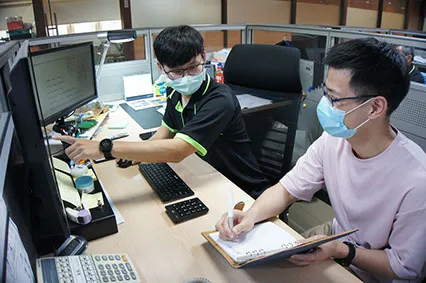
Beyond work, I can feel that everyone’s relationships here are not just those of colleagues processing official business; the company’s overall atmosphere is warmer, more lively, and vibrant. Everyone chats, exercises, plays ball, and has afternoon tea together. When discussing work, managers and the boss tend to use a collaborative approach, merging diverse opinions and taking the best from everyone to explore design possibilities. My own ideas are not bound or ignored; it is a stage where I can exert my own creativity and imagination.
The Reason for the Internship
Actually, when I entered my junior year, the mechanical engineering department started offering elective courses. Each course covered a narrow but deep scope. At the time, I didn’t know what capabilities I truly needed to possess, or which areas I needed to rely on theory to stand firm and use data or logic to prove that my proposed solutions were feasible.
Therefore, I wanted to understand the actual operation of a job through an internship, which coincidentally filled the gap in my summer break before choosing courses. During the course selection process, because I needed to estimate the strength trends of mechanisms through simulation while designing, I chose to take relevant courses on the Finite Element Method. Also, because I assisted in clarifying the relationship between copper wire hardening and elongation at the site during my internship, I chose to study heat treatment and surface modification. Although course selection happened after the situation occurred, and I couldn’t get a more complete and comprehensive answer at the time, I could now quickly propose solutions when similar situations occur. Furthermore, having more explicit sources for verification allows others to understand the basis of my current judgment.
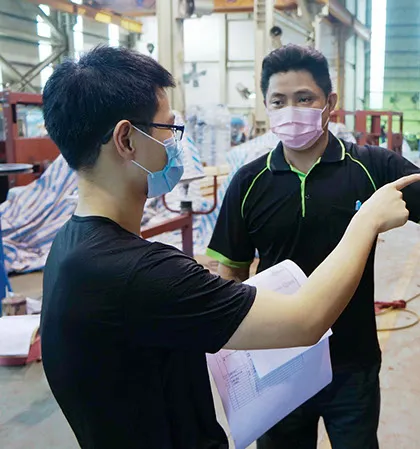
Besides this, I am also thankful to everyone who helped me so much during the internship, whether by giving me many opinions and directions for modification, or kindly answering many questions, which kept me from being at a loss when trying new things. In the process of discussion, different ideas were often sparked to solve the problems faced in design. After this internship, I learned a lot of knowledge and precautions different from those at school, and I became more proficient in this aspect, understanding which areas I can still improve in. At the same time, I met many different people, sharing experiences, playing ball, chatting, or providing other advice. Beyond work, everyone can connect, which gave me a very pleasant internship experience.